Tuesday, May 26, 2015

LIGHT ON BADDHA KONASANA, or BOUND ANGLE AS A PEAK POSE

We did something different in class this last week—we practiced a sequence of asana that used Baddha Konasana (Bound Angle 128-29) as the peak pose. That might not sound terribly exciting or noteworthy, yet I find myself continuing to think about it several days afterward.

This is an undervalued posture that typically gets relegated to the sidelines. To the best of my memory, in ten years of teaching, I have never positioned it as the peak of a sequence, nor do I remember ever being led into it as a peak by another teacher. I have certainly practiced and taught it many times, but always as either a preparation for further hip-opening or as a counter/cool-down following back bends or inversions. I certainly enjoy and appreciate the pose, but I've never highlighted it. I think it’s time to put Baddha Konasana in the spotlight, and give it a chance to gift us all that it has to offer.

The reason why it became the peak for us this week is because we, as a class, are progressing through the series of poses immediately preceding Padmasana (131) in the text. For the last several weeks, we have focused intently and mostly individually (basically one week at a time) on Navasana variations, the deep adduction poses (Gomukhasana and Lolasana), and Virasana variations (including reclining and back bending). Baddha Konasana is the last pose in this particular (albeit unconventional, see pervious post) sequence before Padmasana, and I nearly skipped it as its own peak. I considered moving straight from Bhekasana to Padmasana and only including Baddha Konasana as a preparatory pose with Lotus as the peak. While that would have been more conventional, I am so glad that I decided otherwise.
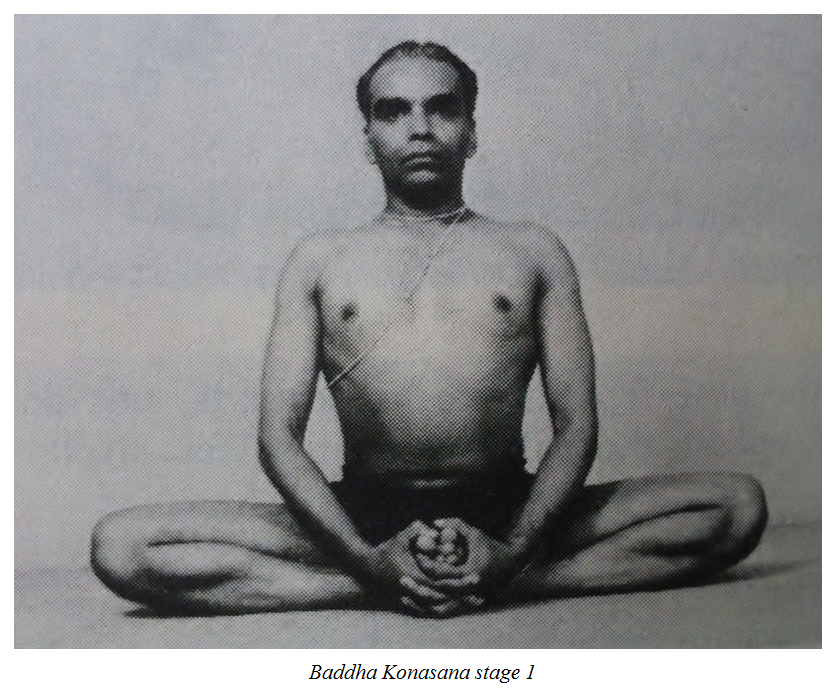
Mr. Iyengar certainly seems to have been a fan of the pose. He dedicated half a page in the text to describing its positive effects, and says it benefits the elimination and reproduction organs of both men and women, it can be soothing for sciatica, and it can be used during pranayama and meditation practices. Seated forward folds in general, particularly “mild” ones like this, are considered to be calming and revitalizing for the nervous system, and they are associated with relieving minor back aches. It is equally respected and promoted in the Ashtanga system as well. There are three different variations of it practiced in the Primary Series. Not only is it considered an important posture in these major traditions, but it also shows up in both of their “short forms.” By that I mean that both LoY and the Primary Series have condensed versions (sometimes referred to as “short forms”) of their particular sequences that can be practiced when one doesn’t have sufficient time in which to practice the sequence in its entirety, and when you only have time to practice some of the poses, both traditions recommend retaining Baddha Konasana. Seated hip openers, Baddha Konasana included, are powerful poses, but they are not necessarily “easy” to practice. Baddha Konasana in particular requires a surprising amount of strength. It is a pose most often practiced for its ability to open and make flexible the hips, but in order to experience that, the core, spine, and outer thighs must be strong and stable. In that way, it becomes a deceptively challenging posture to practice well.

Speaking of strong core, spine, and thighs, if you notice the sequence in the text leading up to Baddha Konasna, you will see that there actually is a focus on those things prior to this pose. In fact, the focus in this section is two part: (1) upper body (torso / axial skeleton) strength and stability, as well as (2) lower body (hips down through feet) flexibility and mobility. And those happen to be two things you need a lot of in this pose. Starting back with Urdhva Mukha Svanasana (109) and Adho Mukha Svanasana (110) you get upper body stability. Then Dandasana, Paripurna Navasana, and Ardha Navasana (112-13) compliment that nicely and provide additional upper body stability. Gomukhasana (115) gives lower body mobility while Lolasana (117) combines stability with mobility. Siddhasana (120) is also a combination of stability (in order to sit straightly upright) and mobility (in order to properly fold the legs) although clearly much less intense than Lolasana, and similar to, but also less intense than, Baddha Konasana. Finally the Virasana variations (120-27) are definitely about lower body mobility (particularly feet and ankles), and the reclining and back bending variations (Supta Virasana, Paryankasana, and Bhekasana) further focus on lower body mobility while also incorporating upper body stability. Assuming all of that has gone well as a series of poses, the body should be well prepared for, and happy to receive, the tall and open shape of Bound Angle—the core, spine, and outer thighs should be capable of providing adequate supportiveness while the hips should be supple enough to release fairly readily into a combination of (moderately deep) external rotation and abduction.

Of course this isn’t the only way to prepare the body for this pose, and, in fact, we have talked before about this sequence being rather unconventional. I think it is a good sequence IF you are comfortable performing each of the poses in the sequence. If, however, any of those poses need to be their own peak experience for you with appropriate preparations and modifications beforehand, then using them as a specific means of getting toward Bound Angle may not be your best choice. It doesn’t make it bad or wrong, but it is possible that some other route, with some other sequence of poses, would better prepare you.

The following is the sequence we practiced together on Sunday with a few extras added in. Like the series of poses presented in the text, it is just one way (not the only, not the best, just one) to practice with Baddha Konasana as the peak pose. Feel free to add/subtract/modify/rearrange anything to fit your needs/desires; it can even be turned into a flow-style practice if you like. I’m not providing how-to instructions here for form or alignment (just a list of pose names), so if some pose is unfamiliar to you, skip it, replace it, or Google it. I might suggest trying both of these sequences (the one from LoY and the one shared here), and just experiment with your body. Notice challenging moments and easeful moments, what works and what doesn’t, and how you feel afterward. There isn’t a right or a wrong; only two different ways to get to the same place—with much deserved light on Baddha Konasana.


Props: a wall, a strap, 2 blocks (preferably 4”)

[Reclined hip and leg openers]
wind-shield wiper twist/stretch
Succirandhrasana (thread-the-needle)
Garuda’s (Eagle pose legs) twist

     repeat wind-shield wipers, Succir., and Garuda’s twist a second time on each side

Ekapada puvanna muktasana (“EPPM,” hug one knee to chest and then to armpit)
Supta Padangusthasana I prep. (reclining hand-to-big-toe pose variation with hands clasped behind top thigh)
Supta Padangusthasana I fuller form with a strap or hold on to big toe

     repeat EPPM, Supta P. prep., and Supta P. a second time on each side

Supta Padangusthasana variation with top leg extended out to side, and a BIG external rotation to the top leg

Supta Padangusthasana variation with top leg out to side, a big external rotation, then bend your knee to bring the heel toward your groin for a reclined variation of one-legged Bound Angle, then position the top leg into Half Lotus, and finally bend the bottom knee for a Half Lotus variation of Thread-the-needle

[Standing poses]
Downward-facing dog (AMS)
walk hands back to Uttanasana
Tadasana

Uttanasana, walk hands out to AMS
vinyasa
AMS lunge (“down dog lunge”) each side
Lizard lunge (forearms down) each side
AMS to Uttanasana
Tadasana

Utkatasana to Uttanasana
Garudasana legs
     repeat Garudasana either just legs or add the arms for the second round
Uttanasana
vinyasa and take 2 extra breaths during Upward-facing dog

[Seated hip openers]
Gomukhasana legs
     repeat Gomukhasana either just legs or add the arms for the second round
Virasana, practice all four feet positions as presented in the text
Supta Virasana
Paryankasana with one block under each shoulder blade, practice with straight legs if Hero legs are uncomfortable
AMS with strong, straight legs; no pedaling or fidgeting

Agnistambhasana (Fire log pose)
Siddhasana at the wall with a block positioned behind your upper back; stay for 2-5 minutes
Upavistha Konasana at the wall with a block positioned behind your upper back; stay for 2-5 minutes

Baddha Konasana at the wall with a block positioned behind your upper back; stay for 2-5 minutes
Baddha Konasana with a block between your feet; press your feet together firmly and sit up tall as if the block were still behind your back
     1. with block positioned so that its widest edges separate the feet, stay for 1 minute
     2. with block positioned so that its medium edges separate the feet, stay for 1 minute
     3. with block positioned so that its narrowest edges separate the feet, stay for 1 minute
Now try Baddha Konasana without the block
If your hips feel open and your knees are on (or very close to) the floor, fold and stretch your spine forward to bring your chin to (or toward) the floor in front of your feet

[closing and resting poses]
Bharadvajasana I and/or II
Janu Sirsasana
Setu Bandha Sarvangasana (Bridge pose)
reclined twist of choice

Savasana
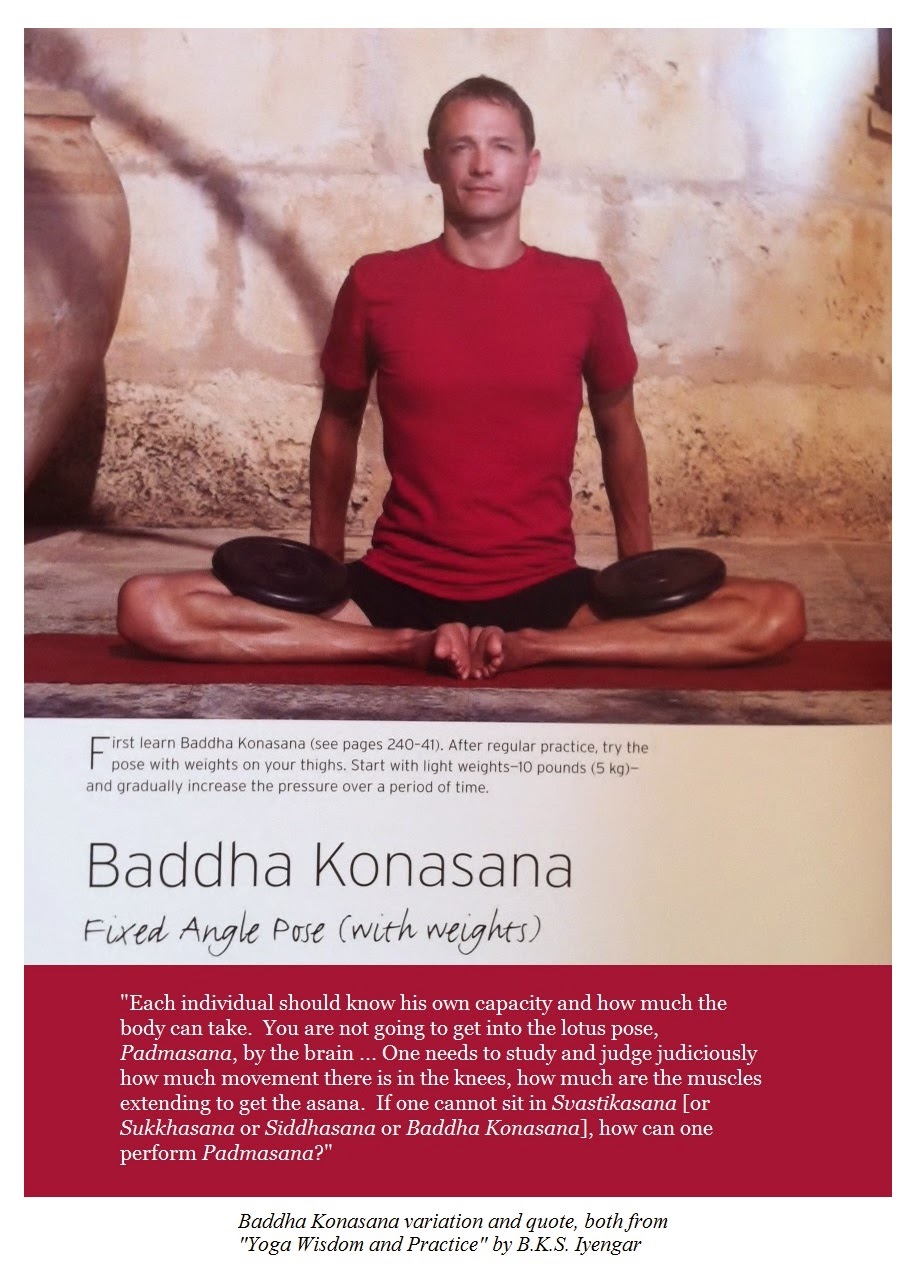


Iyengar, B.K.S., Yoga Wisdom & Practice: For health, happiness, and a better world. London: DK, 2009. Print.


Thursday, May 7, 2015

KULA--CONTACT YOGA

Click here to read a piece entitled Kula--Contact Yoga which I recently contributed to the "Live a Grounded Life" blog hosted by Solid Roots Yoga.

Enjoy! And, as always, let's practice together soon and often.

Saturday, May 2, 2015

UNCONVENTIONAL SEQUENCING, or HOW UP-DOG AND HERO PREPARE YOU FOR LOTUS

My early relationship with Light on Yoga, like most people's, was as a kind of reference book. I didn't view it as a whole, as an ordered development of poses with a beginning, middle, and end. In fact, in some ways, it seemed entirely without order. When I had a question or curiosity about some particular posture, I would pick it up and flip right to the index. Then I would go to the page for that pose to look at its pictures and read its instructions, and that's it. It didn't occur to me to look at the pose(s) before or after. It didn't occur to me to look for patterns or sequences or to think of it as a self-contained practice. Instead it was almost like a phonebook of asana -- you don't read the phonebook from beginning to end; you go right to the information which is most relevant in that moment. In that way, LoY helped me connect to individual poses. I loved it for that. It wasn't until years later -- and over the slow course of several year's worth of time -- that I realized there was something much more deliberate and noteworthy in its organization. And that made me love it even more.

If you look closely there is a decipherable sequence within the book as a whole, but one that is only fully accessible to very experienced practitioners. In other words, one could use the book as a manual for a full-spectrum practice beginning with Tadasana and ending with Savasana with all of the asana from basics to advanced in between. But if you are not a very experienced practitioner capable of full-spectrum advanced postures, please do not discount the value of this book. There is a wealth of information in its pages -- some of it sits lightly on the surface ready to be known as soon as you crack it open while other parts are more deeply buried and are only discoverable to those who invest the effort and patience necessary to shine light on them.

Something accessible to all students, regardless of experience level or postural capacities, is the mini-sequences found throughout the text. They may not be immediately visible upon simply turning the pages. But they are there, and they're worth noticing.

There are lots of these so-called mini-sequences in the book, and I think the set of poses immediately prior to Padmasana (Lotus pose, 129-32) is particularly interesting. My experience as both a student and a teacher has often included lots of external rotation and abduction work as direct preparation for Lotus -- essentially all kinds of poses and variations of poses that encourage the inner thighs to stretch and widen; poses that mimic the basic form of Lotus's pretzel-y legs without the full intensity of that difficult position. That's a typical approach, and a reasonable one, as well.

However, that is not exactly the way it is presented in LoY. The sequence of poses preceding Lotus in the book includes a combination of core-strength and hip-opening. The hip-opening, though, isn't what you would expect. It is mostly internal rotation and adduction. Why would core-strength, internal thigh rotation, and adduction be placed just before Lotus pose? This is one of the reasons why the text sometimes seems disorderly rather than methodical. It is true that the sequence is unconventional, but it is not disorderly. There is a method embedded in the madness.

Let's consider this particular mini-sequence as starting with Urdhva Mukha Svanasana (Upward-facing Dog pose, 109) and ending with Padmasana. It would be as follows:

     Urdhva Mukha Svanasana (Upward-facing Dog pose, "UMS")

     Adho Mukha Svanasana (Downward-facing Dog pose, "AMS", 110)

     Dandasana (Staff pose, 112)

     Paripurna Navasana (Full Boat pose, 113)

     Ardha Navasana (Half Boat pose, 113)

     Gomukhasana (Cow-face pose, 115)

     Lolasana (Pendant pose, 117)

     Siddhasana (Adept's Seat pose, 120)

     Virasana (Hero pose, 121-23)

     Supta Virasana (Reclined Hero pose, 124)

     Paryankasana (Couch pose, 125)

     Bhekasana (Frog pose, 126-27)

     Baddha Konasana (Bound Angle pose, 128-30)

     Padmasana (Lotus pose)

In short, what is happening here is this set of poses is providing lower-body mobility (opening and loosening for the ankles, knees, and hips) while simultaneously creating torso strength and stability via the back bends and abdominal poses. Lotus pose, keep in mind, is meant to be used as a stable seated position for practicing pranayama (breath exercise) and meditation techniques. If the muscles of the torso, either along the belly or the spine, are weak, you will not be able to sit for any kind of prolonged practice period. And, of course, if your ankles, knees, or hips lack suppleness, you won't be able to get into the pose at all, let alone sustain it. Therefore, the poses immediately preceding Lotus pose provide the stability and mobility needed to be in the pose.

In case it still isn't entirely clear as to how all of that is happening here, I'll highlight a few specific points.

First, UMS, AMS, Staff pose, and Full Boat pose are strikingly similar when the form of the upper-body is considered. Look at them side by side:


Notice the shape of the chest in particular. With only a minimal repositioning of the arms and head along with a change in the relationship to gravity, these four poses have a lot in common. UMS and Staff pose are essentially identical with the exception that UMS places the legs in extension which makes the pose a back bend while the legs are flexed into a forward bend for Staff pose.


AMS, Staff pose, and Boat pose are essentially a single physical form interpreted three different ways relative to gravity.


These four poses (UMS, AMS, Staff, and Boat) are presented sequentially in the text, at least in part, because they are clearly related to one another in physical form. Each one provides a preparation or compliment for the one following. And they can easily be practiced in a continuous flow-style movement: from UMS, the hips lift and the chest presses back into AMS; from AMS, the legs jump through the arms to sit for Staff pose; from Staff pose, the body rocks back to balance on the buttocks for Boat pose; from Boat pose, the hands press into the floor next to the hips, the legs swing back through the arms, and the chest lifts for UMS; and so on. In other words, not only are these poses really important individually, but this mini-sequence is also the beginning of the Sun Salutation components. This is the first place that LoY presents a kind of "vinyasa."

The next pose is Ardha Navasana (Half Boat pose) which provides additional core strengthening. It is a more intense version of Full Boat. What make it more difficult is the clasp of the arms behind the head plus the repositioning of the torso and legs much closer to the ground. But those characteristics are what makes it so effective -- they challenge the muscle groups in a different way than Full Boat. Also the abdominal strengthening postures are included here to prepare you, in part, for the inversions that are not far away when the sequence is viewed as a whole.

Gomukhasana (Cow-face pose) takes a break from the strong core work, but not for long. Here is the beginning of more focused attention on the mobility of the hips, knees, and ankles. The standing poses, belly-down back bends, and core work that precede this pose emphasize generating heat and stability. This is something a little different: it highlights stretching and flexibility more so than strength. And it serves as a transition pose between what has already happened and what is about to happen. By combining the stability of the UMS arms and Staff pose spine with the strength of the Boat pose abdomen and the bendy Cow-face legs, you get the next pose: Lolasana (Pendant pose).


Pendant pose is the first of many arm-balances presented in the text. And, not only is it the peak at the end of its own mini-sequence (UMS + Staff + Boat + Cow-face = Pendant), it is also another component of the traditional Sun Salutation insofar as it prepares you to jump and swing the legs either forward or backward through the arms.

Mobility in the hips, knees, and ankles continues to be the primary focus in the next pose which is Siddhasana (Adept's Seat pose). But, different from the previous poses, now we see the first posture which utilizes external rotation and abduction at the hips. In this way, it is both a kind of counter-pose to what preceded it (Cow-face and Pendant both position the legs in internal rotation and adduction) as well as a sneak-peak into what is developing.


After that brief break, we go back to the internal rotation and adduction position of the hips and legs to practice several different stages of Virasana (Hero pose), and the focus is still on mobility in the hips, knees, and ankles. The deep flexion of the knees, the stretch for the ankles, and the upper-body seated on the feet in this way make Hero pose similar to Cow-face pose.


But the adduction of the thighs is lessened in Hero pose making it less intense for the hips. Notice that in Cow-face the legs are crossed above the knees so that the thighs move beyond the midline whereas in Hero pose the thighs are joined at the midline. In some ways, it would make sense to place Cow-face after Hero pose as it is a more difficult position for the legs, and therefore Hero could serve as a preparation for Cow-face. You certainly could do that. However, the advantage of practicing Cow-face first is that the challenge of Hero pose is greatly dissipated if you have already prepared the hips in the more extreme form; that is to say, if you can comfortably practice Cow-face legs, then you can surely practice Hero legs as the latter is less demanding. And, if by the time you enter Hero pose, your hips and knees are adequately prepared, you can focus your attention on other important components of the posture, such as the feet and upper-body.


There are four different positions for the feet in Hero pose, and each one provides a slightly different stretch for the lower legs, particularly the ankles. The final form is when the feet rest on either side of the hips (rather than underneath them) and are pointed straight back so that the inner and outer ankles are equally extended. At this point the upper-body experiences four additional stages of Hero pose.

After the forward folded stages of Hero pose come the supine stages known as Supta Virasana (Reclined Hero pose) and Paryankasana (Couch pose). These two poses continue the theme of ankle, knee, and hip mobility, and they add a focus of stretching the hip-flexor muscles along the front of the thighs and into the lower abdomen. Tightness in the hip-flexors will prevent the femur bone from sitting properly inside the hip-socket. If the femur bone is improperly positioned, it will limit your ability to fold the legs into Lotus pose. So even though these poses don't much resemble Lotus in their physical form, practicing them first is a huge part of preparing for it.


Then, you simply flip over to a prone position and repeat the same basic form while on your belly for Bhekasana (Frog pose). It continues to open the hip-flexors and strengthen the spine, and the contact of the hands against the top of the feet further stretches the ankles in cotninued preparation for Lotus pose.


Similar to Siddhasana seen earlier in this sequence, Baddha Konasana (Bound Angle pose) serves as both a counter-pose to what has just taken place (the deep internal rotation, adduction, and hip-flexion of the Hero pose variations) as well as a sneak-peak at what follows (Lotus pose is next). All of the preceding attention to the hips, knees, and ankles has presumably prepared the body to achieve this mild hip-opener with relative ease. At this point, the lower body is quite supple, any pressure otherwise experienced in the ankles or knees has likely been relieved, and, not only do the thighs open easily now that they are properly positioned within the hip-socket, it probably feels very good to allow them to do so. Of course, if you got to this point and didn't feel supple in the hips, knees, or ankles, then you probably would not want to proceed into Lotus pose.

The only posture left is the peak of our mini-sequence: Padmasana. Utilizing everything we have covered up to this point -- stable spine, uplifted chest and upper-back, strong belly, open hips, bendy knees, and mobile ankles -- each foot is carefully positioned over the top of the opposite thigh to create Lotus pose.


You can certainly see the similarities between Siddhasana, Baddha Konasana, and Padmasana, and why they would commonly be used as preparations for each other.


And it is understandable that the direct correlation between Hero pose and Lotus pose is often overlooked. They don't appear at first to have that much in common. But if you look closely, you can see traces of Hero legs in Lotus legs. And, of course, their relationship makes much more sense when viewed from the context of the particular sequences of events we just explored.


Again, this is definitely not the most conventional means of sequencing Lotus pose. And it probably isn't the best way to initially learn the pose. This particular sequence is probably most effective for those people for whom these poses are already well-established. They can each be broken down and their component parts better understood by placing them in other postural arrangements. Then this unique mini-sequence can be explored and experimented with.

As I mentioned earlier, Lotus pose is often used during pranayama and meditation practice, and for that you want the body to be as comfortable and stress-free as possible. That makes a build-up to Lotus itself a fantastic peak-pose sequence. But, of course, this isn't the end of sequencing in the book. Now that Lotus pose has entered the practice, it plays a major role in many of the subsequent asana. The next section of the book revisits most of the basic forms we were just introduced to but now with Lotus legs -- arm-balancing (Tolasana and Kukkutasana), back bending (Simhasana and Matsyasana), forward folding (Baddha Padmasana), etc. Then, all of that hip-opening is utilized in a series of poses focused on basic forward folding techniques. Following that, Lotus legs shows up again in several variations of inversions, more challenging arm-balances, and deeper forward bends later on, all of which have their own mini-sequences embedded within.

This short thirty-page section alone is rich and deep with work that could keep us studying for a very long time. As you see, not only are the individual poses essential for their own sakes, there are sequences inside of sequences which have the potential to unlock all new avenues of understanding and awareness and experiences.

Barring any limitations which would prevent a safe practice, I encourage you to try this mini-sequence and see how your body responds to it. Or find your own mini-sequence to play with. As a whole, LoY may not be conventional in its sequential presentation, but it does have order. And sometimes the unconventional approach takes you exactly where you wanted to go all along, just in a brand new way.


Monday, April 20, 2015

BOOKS ON YOGA

I have admittedly not been writing much the last few weeks. What I have been doing instead, among other things, is reading a lot. Once in a while it's necessary to step back from the effort of output and simply receive for a while. Teachers need to be students. Artists need to be patrons. Performers need to sit in the audience. That seems obvious, yet certain of us tend to forget how imperative it is to replenish our wellspring. I know I sometimes focus too narrowly on what I'm doing -- as in creating, producing, exhibiting -- and feel a kind of inadequacy in the moments when that naturally ebbs. When you are engaged in active production of any kind there will inevitably be moments of deceleration or even stagnation. Rather than contentedly pausing to reflect or witness or restore, I often catch myself being self-critical.

That is a common experience for yogis, especially following a period of great progress. Maybe this has happened to you: you find a teacher that really resonates with you, or a practice-style that motivates and energizes you, or for some other reason you have a physical or mental breakthrough. Suddenly every practice is better than the one before, and your stiff places are softening while your weak places are stabilizing. And pose after pose feels like your new best friend. It's almost as if the asana are alive inside of you, and every day you can't wait to roll out your mat so that you can shape and reshape yourself.

Then you hit some sort of yoga wall, a plateau. It isn't that practice has stopped feeling good; you'd still rather practice than not. But it's somehow a little bit harder to get on the mat, and a little bit harder to move your body. And the challenge of learning some new pose or technique sounds more effortful than it does rousing. It happens to everybody.

There are innumerable ways to address and combat apathy. My point here isn't really to advise you on how to do so, but simply to validate it as a normal experience. I feel it on the mat and off. And for me, the best remedy is to give myself permission to stop putting forth and to just take in. One can only expend so much before revitalization becomes necessary.

Since that is where I have found myself lately -- in need of replenishment -- I thought I would share with you some of the yoga-related books I have enjoyed. Whenever I'm feeling disconnected or unmotivated, I go to the library or bookstore. And whatever I pick up almost always has the word "YOGA" in the title. This is by no means an exhaustive list; great yoga literature abounds, even fiction! If you're looking for something covering a particular topic, I just might be able to point you in the right direction regardless of the subject matter, but I personally gravitate toward history, philosophy, and anatomy. If you have a favorite which I don't mention, share it with me. And something we could all benefit from remembering from time to time is that inspiration will strike again; it always does!


First of all, I think every serious yoga teacher and student should own at least two copies of both the "Bhagavad Gita" and "Patanjali's Yoga Sutra." There are dozens of translations of both. Some have commentary, and some don't. Some very much attempt to preserve original intentions, and contexts and some present more modern interpretations. There are even some written for specific audiences -- Americans, women, youth, etc. These are my two favorite translations of each:

   Bhagavad Gita: A New Translation by Stephen Mitchell (on Amazon)
   The Essence of the Bhagavad Gita by Paramahansa Yogananda (on Amazon)

   The Yoga Sutras of Patanjali by Swami Satchidenanda (on Amazon)
   The Yoga-Sutra of Patanjali: A Translation with Commentary by Chip Hartranft (on Amazon)

The Palace of Illusions by Chitra Banerjee Divakaruni
This is a great work of fiction which weaves together Indian history and mythology to tell the story of the Bhagavad Gita from the perspective of Arjuna's wife. I think it's enjoyable whether or not you are familiar with the traditional telling of the story, but it is especially intriguing if you know the characters and events well. (on Amazon)


How Yoga Works by Geshe Michael Roache
This book uses a fictional story to present the basics of yoga philosophy, namely Patanjali's Yoga Sutra. The story is captivating, and it turns the ambiguousness of the Sutra's aphorisms into practical and relatable prose. (on Amazon)


Holy Cow: An Indian Adventure by Sarah Macdonald
Marriage and career force the author to return to India after a failed visit in her youth. This memoir tells of her initial aversions and skepticisms, the experiences she has and relationships she forms, and her eventual appreciation of a place and culture as capable of providing happiness and fulfillment as any she could find elsewhere. It's about self-awareness, tolerance, resilience, and humility. And it's funny. (on Amazon)


Gurus of Modern Yoga by Mark Singleton
The word "guru" has become a modern term referring to anyone with even the slightest amount of knowledge or experience in some particular subject matter. Traditionally, however it represents something much more refined and powerful. These essays are a history lesson in what makes a guru, how their teachings develop, and how they're disseminated. Several teachers who have played an essential role in the development of modern yoga are included here: Swami Vivekenanda, Sri T. Krishnamacharya, John Friend, and more. This is a great book for those interested in yoga history and lineages. (on Amazon)


Autobiography of a Yogi by Paramahansa Yogananda
Every serious yoga teacher and student should read this book at least once. (on Amazon)


Yoga and the Hindu Tradition by Jean Varenne
A short but important work on the tenets of Classical Yoga. It is philosophical and theological in nature, but clear and understandable. It serves well as an introduction to yoga philosophy for those either new to yoga or new to reading philosophy. (on Amazon)


Light on Life: The Yoga Journey to Wholeness, Inner Peace, and Ultimate Freedom by B.K.S. Iyengar
This is Iyengar's big book of everything yoga except the asana. He expounds of philosophy, spirituality, culture and lifestyle, emotions and psychologies, and more. He makes it clearer than ever that yoga is available to anyone who wants it. (on Amazon)


Ramayana: Divine Loophole by Sanjay Patel
Sanjay Patel is an amazing artist and author. He takes the theologies and mythologies of his childhood, and turns them into both remarkable pieces of art and modern literary interpretations. The Ramayana is a dense and intense traditional Indian story, and he makes it come alive in a fresh, page-turning way. This, along with his other equally enjoyable works, will definitely turn you on to classic Indian literature. (on Amazon)


The Great Work of Your Life: A Guide for the Journey to Your True Calling by Stephen Cope
I love Stephen Cope! I have read each of his books multiple times, and this one is my favorite. This book is about discovering your life's work and passion, and then embodying it. Fears, obstacles, peer-pressures, and responsibilities often prevent us from achieving that which is most important, most dire to our sense of individuality and self-satisfaction. Through others' success stories -- some famous and some not -- we are shown how to get out of our own way, and be exactly who we are meant to be. And when you are done with this one, be sure to read "The Quest for the True Self" and "The Wisdom of Yoga" as well. (on Amazon)


There are so many more, but I'll stop there. I may have even mentioned some of these already in previous posts. I know on at least one occasion I provided a list of books specifically related to the Iyengar method of practice (see post: "Supported and Unsupported").

Everybody needs an occasional reboot, a jolt of insight or inspiration. And yoga doesn't just happen on the sticky mat. The whole world, its experiences and phenomena, are your practice. It's just far too rich of a topic to restrain to asana. Happy reading.


Monday, April 6, 2015

NAMASTE: A LOVE LETTER TO YOURSELF

Click here to read a piece entitled Namaste: A love letter to yourself which I recently contributed to the "Live a Grounded Life" blog hosted by Solid Roots Yoga.

Enjoy! And, as always, let's practice together soon and often.

Thursday, March 26, 2015

FIVE IMPORTANT POSES

I was recently working with a group of students on the components of belly-down back bends which is really tough stuff. They are deceptively challenging poses because from the outside they appear to be petty plain, even easy, but a whole lot is happening just beneath the surface. Poses like Salabhasana (Locust, 100), Makarasana (Crocodile, 101), and Dhanurasana (Bow, 102) require strength in your legs and all along your spine - front and back - as well as openness in your hips, chest, and shoulders. Part of their challenge comes from the effort it takes to lift yourself up against gravity. Not only is that difficult by itself, but it is made even more so in this case because you can't use your arms for help. And, even though in the long-run they actually serve to improve respiration, lying prone sometimes makes breathing feel restricted. So, while they are "simple" and "fundamental" poses, they are not by any means easy. And for that reason we were discussing the purpose and importance of these poses in an effort to encourage continued practice of them.

During the class I made a kind of off-handed remark about Locust pose being one of the most important postures; possibly in the top five of all time if you were to make yourself a list. Later on I found myself thinking about that comment, and I wondered what would my top-five asana list actually include?

Mr. Iyengar provided his own list of "important asana" in LoY, and I have already commented a little on that (see previous post: "Most Important Asana"). I think his is a great compilation of fundamental postures that nearly anybody would benefit from (see disclaimers below). Although mine does overlap with his, that wasn't conscious on my part; it just speaks to the merit of the poses. And given a list longer than five, mine would differ slightly (see below).

A few things should be kept in mind as I share this with you. First, this is solely my opinion. This is what seems appropriate to me given my experiences as a student and an instructor. Other people, with other experiences or other trainings, may have different opinions. And none of us would be right or wrong, just different.

Secondly, the list does not take into consideration contraindications. By that I mean the list assumes that you are capable of performing each of the poses in their full (or nearly full) form free from any overt risk of injury. I do not mean to imply that you mustn't need the assistance of props or some kind of modification, but that the basic form of the pose is accessible and appropriate for you. If, for instance, you recently suffered a neck injury, you shouldn't be performing Shoulderstand as that is explicitly contraindicated. However, if your neck, spine, and shoulders are generally healthy and fit, but stacked blankets help you maintain good alignment, then you can practice Shoulderstand. In other words, if any of the poses are inappropriate for your practice, then your list would need to be adjusted accordingly.

Thirdly, by "most important" I do not mean favorite poses or the most fun poses or the ones most frequently requested. This is not a list based on popularity. I promise you that if the list were titled "my personal favorite poses to practice because I love them and they feel good," it would be a very different list. What I mean is these are the poses whose basic forms and functions provide the most benefit to a general practice; the ones which are arguably the most advantageous physically and metaphysically. Their teachings are deep and multi-layered, and continue to be so whether we have practiced them one time or a thousand times.

Lastly, Tadasana (Mountain pose, 61) and Savasana (Corpse pose, 463) are implicitly listed as they are essential elements of postural practice. Do not think that I am ignoring them, and do not discredit them for yourself. They are imperative.

With that being said, here, in no particular order, is my list of the five most important yogasana:

  • Adho Mukha Svanasana (Downward-facing dog, 110)
  • Salabhasana (Locust, 100)
  • Salamba Sarvangasana I (Supported Shoulderstand first variation, 205-13)
  • Janu Sirsasana (Head-toward-knee forward bend, 149)
  • Prasarita Padottanasana (Wide-angle forward bend, 81)

I'll make a few comments to explain each of my choices.


Adho Mukha Svanasana. Even though I said the list was presented in no particular order, if there were an order, I would put AMS in first place. This singular pose contains a nearly complete practice all by itself. It provides stability and strength to the legs which are toned into a neutral "Tadasana" position. It also generously stretches the legs from the buttocks through the heels. It opens the hips and pelvic-floor. It tones the abdomen. It lengthens the spine. Its weight-bearing component adds upper-body strengthening which prepares you for arm-balancing and inverting. It stretches the arms, shoulders, and side-body. It opens and loosens the upper-back. It is an inversion because the hips are higher than the heart and the heart is higher than the head. But because the feet stay anchored, it is less strenuous than more overt inversions such as Headstand and Shoulderstand which makes it a more appropriate choice for some people. In that way it serves as either a preparation or a replacement for upside-down poses. It can serve as a warm-up before activity or a cool-down afterward because, by adjusting just a few key actions, it can energize or soothe. It is known to have positive effects on the nervous system as a whole, including respiration, brain function, blood circulation, and heart health. And it is the beginnings of understanding the idea of "root down in order to rise up" which is vital for both physical and metaphysical growth. It is really unparalleled.


Salabhasana. The primary function of Locust pose is to strengthen the spine's extensor muscles. And it performs that job so well that the pose is a common exercise in many modalities beyond yoga such as Pilates, gymnastics, body building, physical therapy, and more. The reason why it is so effective is because the muscles all along the back are getting undivided attention. By that I mean there is no assistance coming from other body parts, namely the arms as is the case in many other back bends. When you include the arms in a pose like Cobra, for instance, the action is split between a back bend and a push-up. That is not bad, of course; Cobra and poses like Cobra are fantastic. Unfortunately, it is common to allow the strength of the arms to override the capacity of the spine, and then the bend is deeper or the lift is higher than is optimal. In Locust the extensors get to do precisely what extensors do best without any interference or peer-pressure coming from other muscle-groups. In that way it teaches patience, humility, and self-reliance. Additionally, the effort it takes to lift the body up against the force of gravity enhances its effectivenes. And, because the front body is compressed against the floor, the organs of digestion, elimination, and reproduction receive needed stimulation.


Salamba Sarvangasana I. The basic form of Shoulderstand is such a tremendously powerful pose. Of course there are risks involved (every yoga pose involves risk), and it is not appropriate for everybody. However, if you are capable of practicing it, even in a prop-supported or slightly modified way, do so. I will let what Mr. Iyengar has written about its benefits suffice for explanation as it is clear and thorough, and I could not add anything to it to make it any better. If you have not read the Shoulderstand (205-13) and Shoulderstand Cycle (213-37) sections in LoY, I highly recommend it.


Janu Sirsasana. In Sanskrit janu means "knee" and sirsa means "head," so the name of this pose suggests that the head comes to the knee when the truth is that, if the spine is properly elongated, the chin comes to rest on the shin rather than on the knee. If that form of the pose is achieved, along with the recommended width of the thighs, adequate external rotation of the back leg, sufficient reach of the arms, and proper positioning of the trunk, then the pose provides ample opening for the hips; stretch for the legs, back, and side bodies; and elasticity for the upper-back and shoulders. It conditions the internal organs, including stimulating the kidneys, and its deep forward fold is calming.

Most of the seated forward bends share those positive effects. What differentiates Janu Sirsasana, and grants it a position on the list of five, is that it serves as the foundation, the model, for the rest of the seated work: Janu Sirsasana is the seated cousin of Tadasana. From this pose emerge the variations of forward folds in which one leg is in lotus (153-55), hero (156-59), and squat (159-61); those in which the torso is revolved (152, 162, 165, 172) and/or the arms are bound (154, 160-163); the wide-legged variations (164); and the symmetrical forward folded posture known as Paschimottanasana (166-70).

It seems counterintuitive to think that the straight-legged, symmetrical fold would develop after the more pretzel-y asymmetrical folds, but the truth is that it takes the full conditioning of the legs, hips, spine, belly, and arms received by the one-legged poses to properly prepare the body for Paschimottanasana. There are comments in LoY further explaining this idea on pages 148-70, particularly pages 157, 161, and 170.

I think that the series of seated forward folds is the most difficult category of asana, more so than back bends, arm balances, and even inversions. That is primarily because of their relationship to gravity (which limits our ability to manipulate the pelvis and activate the core) in combination with our culturally-developed biomechanical habits (i.e. our tendency to slouch works against us in these poses). As a whole, the collection of poses is meant to provide cleansing and stimulating effects on the internal organs as well as calming effects on the nervous system. But before we can experience those things, Janu Sirsasana needs to be well understood.


Prasarita Padottanasana. LoY provides two variations of Wide-legged forward fold: the one pictured here in which the hands are placed on the floor between the feet, and the one in which the hands are joined behind the back. Other styles of practice recognize other versions of this pose, both formally and informally, and I recommend them as an effective series with this first variation serving as the starting point.

Like all the standing poses, this pose strengthens and tones the feet and legs. It also stretches the legs from the buttocks to the heels very much like AMS. Different from AMS though, and perhaps advantageous to come, is that there is less weight-bearing in the upper-body. Therefore it may be more appropriate for those with wrist or shoulder injuries. Also like AMS, it is an inversion without the stress of lifting the feet. And it serves as either a preparation or a replacement for going upside-down. Because the legs are widened, it is typically more accessible and therefore performed more skillfully, than the narrow-legged version known as Uttanasana (93). If the hands are placed according to the instructions, there is some conditioning for the wrists, arms, shoulders, and even the upper-back. And those effects are enhanced when attention is paid to the "back bended stage" of the pose in which the back is given ample extension.

Even though standing poses such as Triangle, Side-angle, and the Warriors are incredibly important poses, my opinion is that the added benefits of mild weight-bearing and inverting provide enough advantage to this pose to place it on the list of five (within the bounds of the disclaimers mentioned earlier). It also has the perks of wrist, shoulder, and chest stretching when other variations are considered.

Five poses is not very many; it makes for tough decisions. What is missing here, for better or worse, are postures whose primary purpose is twisting, balancing (both arm and leg), and core-strengthening. If the list were expanded to ten or even fifteen, I would likely include poses from those categories. It would be something like this:

Top Ten

  • Trikonasana (Triangle pose)
  • Virabhdrasana I (Warrior pose first variation)
  • Supta Padangusthasana (Reclined Hand-to-big-toe pose, plus variations)
  • Virasana (Hero pose)
  • Jathara Parivartanasana (Reclined twist, plus variations)

and Top Fifteen

  • Navasana (Boat pose)
  • Vrksasana (Tree pose)
  • Ustrasana (Camel pose)
  • Bakasana (Crow pose)
  • Baddha Konasana (Bound Angle pose)

I admittedly put less thought into the secondary lists, so I cannot say I am fully committed to their content. But you get the idea.

The list of five can serve as a foundation for a more full-spectrum postural practice; it can be an outline from which to proceed and grow. It can also be a condensed practice all by itself when time or energy is limited. It could be a way of warming up when you arrive a few minutes early to class. And maybe, for any number of good reasons, you disagree with my list either partially or entirely, in which case you could make a different list for yourself.

Whatever asanas are practiced, however few or many, in whichever forms or levels of skill, the poses serve an important purpose: they better the body as a means of bettering the "something-more-than-your-body." They are an embodiment of the gross serving as a gateway to the subtle; of the material providing access to the spiritual. They affect us in ways that we see and feel, and in ways which are wholly imperceptible. I'll end with a few words regarding asana by Mr. Iyengar:

The yogi conquers the body by the practice of asanas and makes it a fit vehicle for the spirit. ... By performing asanas, the [yogi] first gains health, which is not mere existence. It is not a commodity which can be purchased with money. It is an asset to be gained by sheer hard work. It is a state of complete equilibrium of body, mind, and spirit. ... The yogi realizes that his life and all its activities are part of the divine action in nature, manifesting and operating in the form of man" (41).


(All quotes, images, illustration numbers, and page numbers refer to: Iyengar, B.K.S., Light on Yoga. New York: Schocken Books, 1979. Print.)

Friday, March 20, 2015

PRACTICE WHAT YOU DON'T ALREADY KNOW, or NONATTACHMENT PART 2

Things we don't know how to do or that we think we can't do often intimidate us because it can be scary and embarrassing to face what is unknown or inaccessible. To admit to ignorance, an inability, a wrong-doing, or a misperception is one of the universally hardest things for people to do. And, unfortunately, yoga practice is not immune to that.

Maybe as you have listened to your instructor talk about which poses she is going to lead that day you feel your tummy knot up a little bit as you think to yourself I don't think I can do that or Oh no, that part of my body is really weak. And then you wonder if you have made a good choice to attend that class or if there is still time to move into the back row. Or maybe you see a flier for an upcoming workshop and you say I probably shouldn't go because I've never been any good at those poses.

Maybe just getting yourself into the studio and on to a sticky mat for the first time was difficult because you thought something like I'm not flexible enough to do yoga. I hear that from people all the time, and it drives me crazy! I want to say to them Of course you aren't flexible if you don't do yoga! Most people are not naturally physically fit; doesn't that seem like a good reason to start a practice? And of course you are challenged by those poses you don't practice very often or by those poses you haven't been taught how to do or by those parts of your body that haven't been developed or conditioned yet. That is precisely what yoga class is for.

Practice is (in part) about learning how to do the things you don't or can't currently do. It is about asking for help to attain that which you need but aren't sure how to get. If you could already do all the poses; if you were already strong, flexible, coordinated, patient, compassionate, self-aware, knowledgeable, humble, courageous, and mindful, you wouldn't need yoga. You wouldn't need to attend class. You wouldn't need a teacher's advice and guidance.

Remember Patanjali says that in order to experience yoga's ultimate goal (nirodhah; stilled consciousness) it is necessary to be nonattached (vairagya), to be free from reaction. It is normal to be attached to your sense of self, to think you already know all of your can's and cannot's. It is a natural inclination to protect your selfdom, to avoid damaging your sense of personal identity, and to seek out experiences which confirm, rather than confront, the person who you think you are. But you have presumably come to yoga to affect change, and to relieve some kind(s) of discontent or suffering. It is irrational to think that you can foster change -- that you can experience the results of potential change -- without making any actual changes. Thus abhyasa (practice) and vairagya include being willing to step outside of your comfort zone, to take on new challenges, and to risk hurting your ego.

Certainly this must be done within reason. Not every pose or category of poses is appropriate for every body. Not every risk is worth taking. Not every practice needs to be a psychological confrontation. Practice should include elements which are comfortable and familiar. Those moments when we are engaged in an activity we do well or that feels comfortable are affirming, and they serve as a reminder as to the good and hard work which has already taken place. We need parts of our practice to be simple and free from overt challenge. But if you only practice that which you do well and avoid that which you don't do well, you will more fully imbed your imbalances. Your strengths will become stronger while your weaknesses become weaker. And you will stagnate inside of your self-imposed limitations.

If you said to yourself, for instance, I shouldn't attend that back bending class because I don't know how to back bend, you would be missing the point of the class. It isn't being offered to those who already back bend (although those students would likely also enjoy and benefit from the experience). It is being offered to those who want to learn how. If you don't know how to back bend, and for that reason you avoid going to back bending classes, then you will never learn. And you will remain attached to the label of "non-back-bender."

Don't let what you don't or can't do restrict what you practice. Instead use those things as the (sometimes direct, sometimes indirect) building blocks of your practice. Bring curiosity and provocation with you to the mat. Allow your practice to be one of insight and transformation. Be willing to experiment, to interpret, and to change your mind. Practice what you don't already know. Learn something new.


(Image: Yoga Sutra I.15 as translated by Chip Hartranft, 2003)