Showing posts with label hip openers. Show all posts

Wednesday, June 17, 2015

MORE HIP OPENERS, or INTRODUCTION TO WEEKS 19 & 20 SEQUENCE

Hip-opening has been the primary theme of the DK class in recent weeks. We took a kind of scenic tour into Padmasana by spending significant time in each of the postures immediately preceding Lotus pose in the text (Gomukhasana, Virasana, Bhekasana, etc.). While the work we have been doing is basic in nature (i.e. foundational and preliminarily necessary), it has not been easy or quick. What it has been, as far as I can tell from what I see and hear, is worthwhile and motivating.

Hip-opening postures have a way of being particularly provocative. So many yoga poses are focused specifically on either creating or utilizing hip flexibility. It is understandable that one would feel frustrated or intimidated if the range of motion in their hips was especially limited; it might seem as though a whole world of experience is inaccessible, off the map. Padmasana in particular is, for many yogis, the epitome of yogasana; the Lotus form is often viewed as the embodied definition of yoga. And it is common to have strong feelings of desire toward attaining it as well as strong feelings of insecurity or self-criticism when it is not achievable. Of course, no single yoga pose defines a practice or a practitioner. But a student, who is otherwise fully capable of reminding themselves of that when their steadiness waivers in a one-legged balance or when their back bend is a little more hexagonal than it is circular, is suddenly barreling toward an existential crisis when their legs resist the quintessential pretzel-y-ness of Lotus pose.

It is also a commonly held belief that all kinds of emotions and stresses (positive and negative, conscious and repressed) are bottled up and preserved in energetic states within our hips and pelvis. It’s like a rush hour traffic jam on the I-405 down there. Because of that, working with hip-opening postures often leads to big feelings, and not always ones that we welcome: frustration, fear, doubt, hesitation, impatience. Sometimes they result in an emotional release. Something which was jammed up or impinged suddenly breaks wide open and the force of the flow is unstoppable. You are suddenly overwhelmed with the desire to laugh out loud or cry or shout.

Those with sufficient hip mobility aren’t necessarily in the clear, however. There is often times an inverse relationship between mobility and stability wherein too much openness coincides with lack of strength. That tends to place the burden of stability on some other part of the body, and, in this case, that is typically the spine which stays overly tense and is easily fatigued. A person with ample range of motion in the hips likely faces a task as challenging as that of the too-tight person: toning the legs and hips in order to create appropriate boundaries against which the upper-body finds freedom. So the next time you’re enviously eying the person on the mat next to you whose Gumby-like legs appear to seamlessly fold and unfold, remember that it’s not that they have something you don’t have or are in some way better—that’s not a whole or accurate picture—rather their challenges are different than yours, and your strengths lay in different areas.

Yoga pose insecurities, emotive reactions which occur while on the mat, and the body’s way of compensating for tightness versus openness are each entire conversations in and of themselves, and I’ll resist elaborating on them any further here. For now, what I want to share is the set of poses which will be our focus in the upcoming weeks. They are still primarily hip-openers. However, whereas our recent work has seen a lot of attention on knee flexion, adduction and internal rotation of the legs, and spinal extension, now there will be more forward folding while one leg is straight and the other is maneuvered through a range of hip movements. We are being introduced to the first group of seated forward bends and twists. Of course, along the way, I’ll point out forms and functions, we will look at relationships and repetition of shape, and we’ll work through various stages of experience.

I am going to present the poses here in the order in which they appear in the Course 1 syllabus in the back of the book. That is certainly not the only way they can be sequenced and practiced. It is possible that any or all of them would need specific preparations and warm-ups beforehand. And, for any number of reasons, one or more of them may be inaccessible to you. I’m also including some of the poses from recent weeks as a reminder that this work is absolutely related, and should be a fluid continuation of where we have recently been. Moving forward toward new poses should be in addition to, not in replacement of, what has already taken place.

I recommend experimenting with the poses in between class times: try rearranging their order; try practicing all the lefts sides before the rights sides, and vice versa; try them raw without any warm up for your spine or legs; compare that to how it feels to add a few rounds of Sun Salutations, standing poses, or a series of reclining leg stretches and hip openers (like Supta Padangusthasana variations, Succirandhrasana, or Garuda’s twist) before the seated work; try them with lots of props and with no props. And feel free to add or remove anything that makes it an enjoyable experience for you. I might suggest closing with a Bridge pose or two, maybe Shoulderstand variations, and then a prop-supported Savasana. It’s your practice; make it work for you.


Virasana -- Hero (pay particular attention to the various foot positions)


Triangmukhaikapada Paschimottanasana -- Three Parts Facing West Forward fold


Ardha Baddha Padma Paschimottanasana -- Half Bound Lotus Forward fold


Marichyasana I -- Marichi's Twist I


Bharadvajasana I -- Bharadvaja's Twist I


Bharadvajasana II -- Bharadvaja's Twist II


Baddha Konasana -- Bound Angle


Gomukhasana -- Cow-face


Padmasana -- Lotus


Supta Virasana -- Reclined Hero


Marichyasana III -- Marichi's Twist III


Ardha Matsyendrasana I -- Half Lord-of-the-Fishes Twist I


Tuesday, May 26, 2015

LIGHT ON BADDHA KONASANA, or BOUND ANGLE AS A PEAK POSE

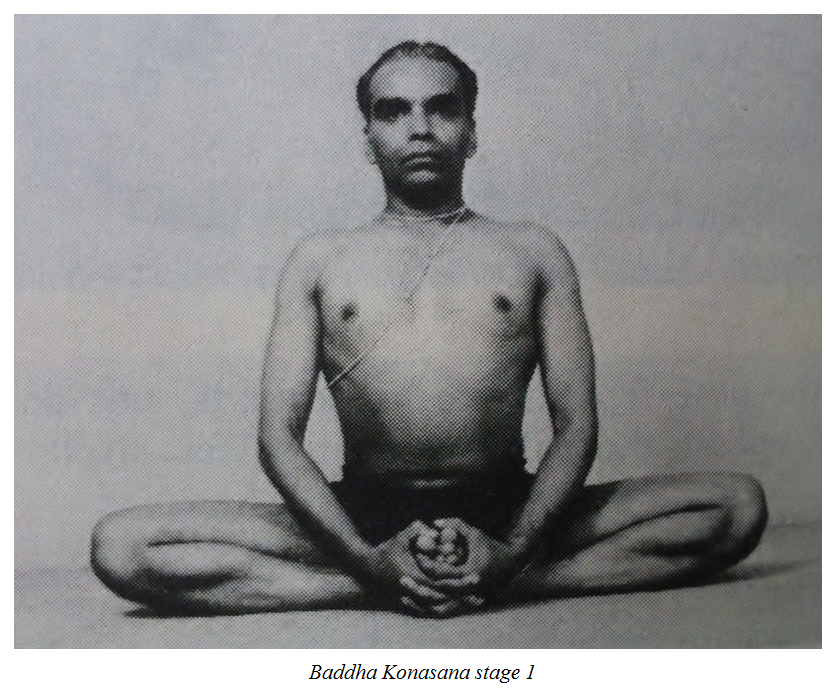
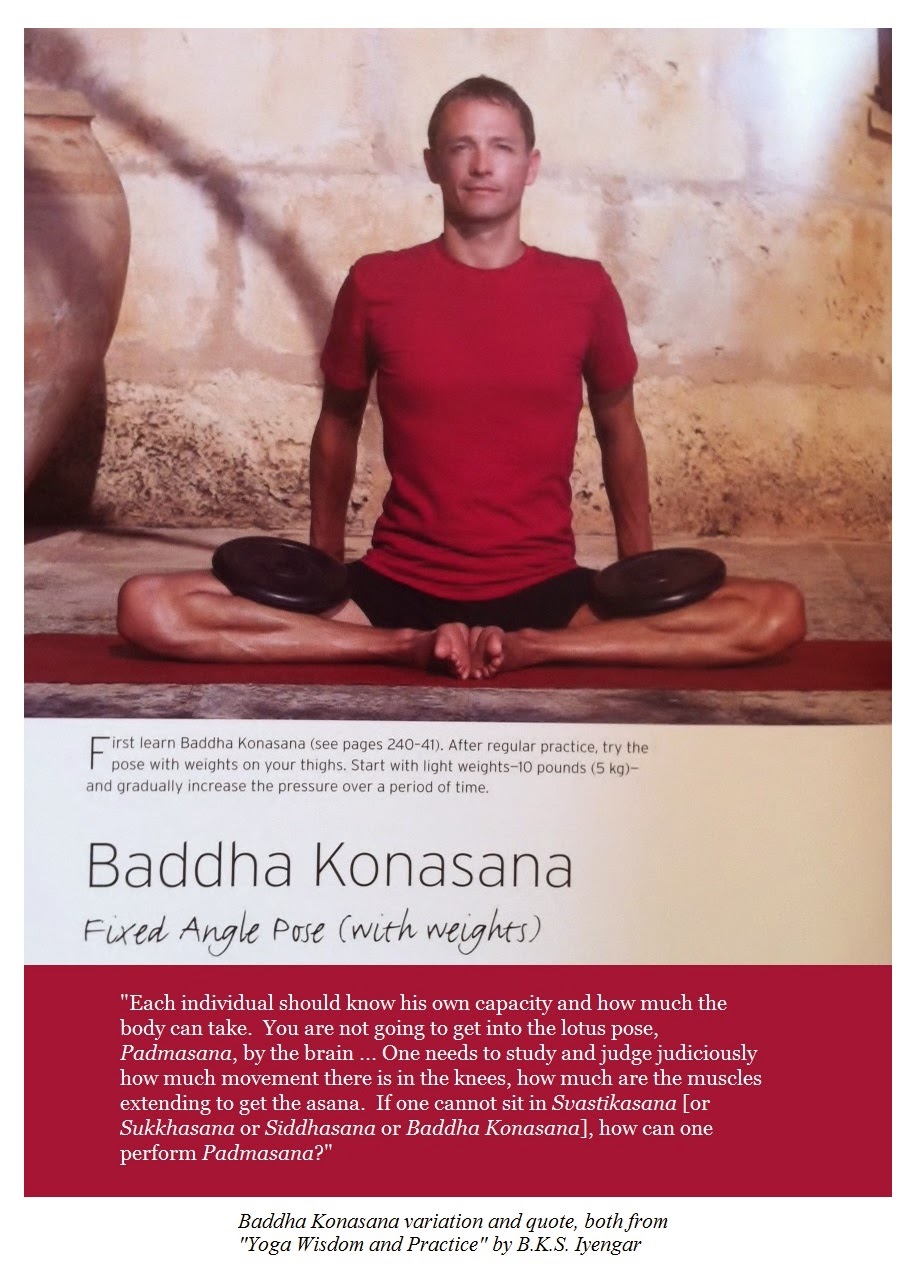
We did something different in class this last week—we practiced a sequence of asana that used Baddha Konasana (Bound Angle 128-29) as the peak pose. That might not sound terribly exciting or noteworthy, yet I find myself continuing to think about it several days afterward.

This is an undervalued posture that typically gets relegated to the sidelines. To the best of my memory, in ten years of teaching, I have never positioned it as the peak of a sequence, nor do I remember ever being led into it as a peak by another teacher. I have certainly practiced and taught it many times, but always as either a preparation for further hip-opening or as a counter/cool-down following back bends or inversions. I certainly enjoy and appreciate the pose, but I've never highlighted it. I think it’s time to put Baddha Konasana in the spotlight, and give it a chance to gift us all that it has to offer.

The reason why it became the peak for us this week is because we, as a class, are progressing through the series of poses immediately preceding Padmasana (131) in the text. For the last several weeks, we have focused intently and mostly individually (basically one week at a time) on Navasana variations, the deep adduction poses (Gomukhasana and Lolasana), and Virasana variations (including reclining and back bending). Baddha Konasana is the last pose in this particular (albeit unconventional, see pervious post) sequence before Padmasana, and I nearly skipped it as its own peak. I considered moving straight from Bhekasana to Padmasana and only including Baddha Konasana as a preparatory pose with Lotus as the peak. While that would have been more conventional, I am so glad that I decided otherwise.

Mr. Iyengar certainly seems to have been a fan of the pose. He dedicated half a page in the text to describing its positive effects, and says it benefits the elimination and reproduction organs of both men and women, it can be soothing for sciatica, and it can be used during pranayama and meditation practices. Seated forward folds in general, particularly “mild” ones like this, are considered to be calming and revitalizing for the nervous system, and they are associated with relieving minor back aches. It is equally respected and promoted in the Ashtanga system as well. There are three different variations of it practiced in the Primary Series. Not only is it considered an important posture in these major traditions, but it also shows up in both of their “short forms.” By that I mean that both LoY and the Primary Series have condensed versions (sometimes referred to as “short forms”) of their particular sequences that can be practiced when one doesn’t have sufficient time in which to practice the sequence in its entirety, and when you only have time to practice some of the poses, both traditions recommend retaining Baddha Konasana. Seated hip openers, Baddha Konasana included, are powerful poses, but they are not necessarily “easy” to practice. Baddha Konasana in particular requires a surprising amount of strength. It is a pose most often practiced for its ability to open and make flexible the hips, but in order to experience that, the core, spine, and outer thighs must be strong and stable. In that way, it becomes a deceptively challenging posture to practice well.

Speaking of strong core, spine, and thighs, if you notice the sequence in the text leading up to Baddha Konasna, you will see that there actually is a focus on those things prior to this pose. In fact, the focus in this section is two part: (1) upper body (torso / axial skeleton) strength and stability, as well as (2) lower body (hips down through feet) flexibility and mobility. And those happen to be two things you need a lot of in this pose. Starting back with Urdhva Mukha Svanasana (109) and Adho Mukha Svanasana (110) you get upper body stability. Then Dandasana, Paripurna Navasana, and Ardha Navasana (112-13) compliment that nicely and provide additional upper body stability. Gomukhasana (115) gives lower body mobility while Lolasana (117) combines stability with mobility. Siddhasana (120) is also a combination of stability (in order to sit straightly upright) and mobility (in order to properly fold the legs) although clearly much less intense than Lolasana, and similar to, but also less intense than, Baddha Konasana. Finally the Virasana variations (120-27) are definitely about lower body mobility (particularly feet and ankles), and the reclining and back bending variations (Supta Virasana, Paryankasana, and Bhekasana) further focus on lower body mobility while also incorporating upper body stability. Assuming all of that has gone well as a series of poses, the body should be well prepared for, and happy to receive, the tall and open shape of Bound Angle—the core, spine, and outer thighs should be capable of providing adequate supportiveness while the hips should be supple enough to release fairly readily into a combination of (moderately deep) external rotation and abduction.

Of course this isn’t the only way to prepare the body for this pose, and, in fact, we have talked before about this sequence being rather unconventional. I think it is a good sequence IF you are comfortable performing each of the poses in the sequence. If, however, any of those poses need to be their own peak experience for you with appropriate preparations and modifications beforehand, then using them as a specific means of getting toward Bound Angle may not be your best choice. It doesn’t make it bad or wrong, but it is possible that some other route, with some other sequence of poses, would better prepare you.

The following is the sequence we practiced together on Sunday with a few extras added in. Like the series of poses presented in the text, it is just one way (not the only, not the best, just one) to practice with Baddha Konasana as the peak pose. Feel free to add/subtract/modify/rearrange anything to fit your needs/desires; it can even be turned into a flow-style practice if you like. I’m not providing how-to instructions here for form or alignment (just a list of pose names), so if some pose is unfamiliar to you, skip it, replace it, or Google it. I might suggest trying both of these sequences (the one from LoY and the one shared here), and just experiment with your body. Notice challenging moments and easeful moments, what works and what doesn’t, and how you feel afterward. There isn’t a right or a wrong; only two different ways to get to the same place—with much deserved light on Baddha Konasana.


Props: a wall, a strap, 2 blocks (preferably 4”)

[Reclined hip and leg openers]
wind-shield wiper twist/stretch
Succirandhrasana (thread-the-needle)
Garuda’s (Eagle pose legs) twist

     repeat wind-shield wipers, Succir., and Garuda’s twist a second time on each side

Ekapada puvanna muktasana (“EPPM,” hug one knee to chest and then to armpit)
Supta Padangusthasana I prep. (reclining hand-to-big-toe pose variation with hands clasped behind top thigh)
Supta Padangusthasana I fuller form with a strap or hold on to big toe

     repeat EPPM, Supta P. prep., and Supta P. a second time on each side

Supta Padangusthasana variation with top leg extended out to side, and a BIG external rotation to the top leg

Supta Padangusthasana variation with top leg out to side, a big external rotation, then bend your knee to bring the heel toward your groin for a reclined variation of one-legged Bound Angle, then position the top leg into Half Lotus, and finally bend the bottom knee for a Half Lotus variation of Thread-the-needle

[Standing poses]
Downward-facing dog (AMS)
walk hands back to Uttanasana
Tadasana

Uttanasana, walk hands out to AMS
vinyasa
AMS lunge (“down dog lunge”) each side
Lizard lunge (forearms down) each side
AMS to Uttanasana
Tadasana

Utkatasana to Uttanasana
Garudasana legs
     repeat Garudasana either just legs or add the arms for the second round
Uttanasana
vinyasa and take 2 extra breaths during Upward-facing dog

[Seated hip openers]
Gomukhasana legs
     repeat Gomukhasana either just legs or add the arms for the second round
Virasana, practice all four feet positions as presented in the text
Supta Virasana
Paryankasana with one block under each shoulder blade, practice with straight legs if Hero legs are uncomfortable
AMS with strong, straight legs; no pedaling or fidgeting

Agnistambhasana (Fire log pose)
Siddhasana at the wall with a block positioned behind your upper back; stay for 2-5 minutes
Upavistha Konasana at the wall with a block positioned behind your upper back; stay for 2-5 minutes

Baddha Konasana at the wall with a block positioned behind your upper back; stay for 2-5 minutes
Baddha Konasana with a block between your feet; press your feet together firmly and sit up tall as if the block were still behind your back
     1. with block positioned so that its widest edges separate the feet, stay for 1 minute
     2. with block positioned so that its medium edges separate the feet, stay for 1 minute
     3. with block positioned so that its narrowest edges separate the feet, stay for 1 minute
Now try Baddha Konasana without the block
If your hips feel open and your knees are on (or very close to) the floor, fold and stretch your spine forward to bring your chin to (or toward) the floor in front of your feet

[closing and resting poses]
Bharadvajasana I and/or II
Janu Sirsasana
Setu Bandha Sarvangasana (Bridge pose)
reclined twist of choice

Savasana


Iyengar, B.K.S., Yoga Wisdom & Practice: For health, happiness, and a better world. London: DK, 2009. Print.